

Thinking Like an Ancestor
In this session we explored how museum objects can help us take a long view on the urgent challenges our societies face. We heard from Ella Saltmarshe, founder of the Long Time Project, who introduced the concept of Long Time thinking and the power that lies within expanding how we think about time. Justine Boussard, founder of the Amateur Ancestor Project then shared her work – and one of her long time object stories – before sharing prompts and tips for how to explore this expansive methodology with your own objects.
By demonstrating how we can expand and cultivate our personal capacity to “do time” in different ways, the session offered new insights into the type of stories your objects can unlock, and a renewed faith in the importance of historic collections in inspiring informed, meaningful, sustained action.
We opened the session with a question to the group – how do you currently experience time?
We invite you to stop reading for a moment and ponder this question for yourself before reading on…
Participant’s responses showed a wide variety of experiences of time.
I experience time when looking in the mirror each morning! 🙂
My nieces growing up!
Slow centred time doing yoga
During a deadline how time works…also, in really long boring meetings!
When learning a new skill
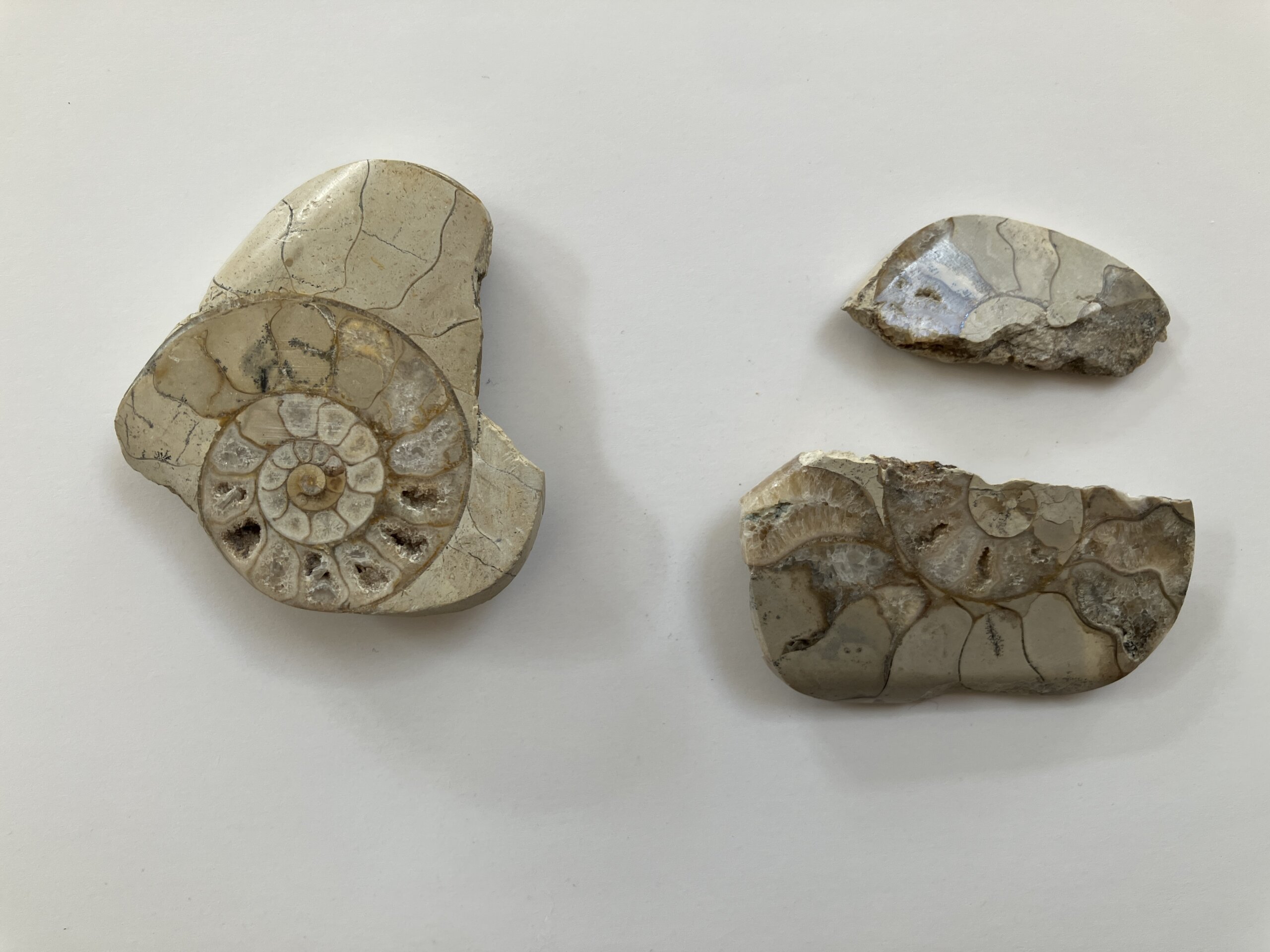
Feeling humble when looking at my fossils
It stands still when looking at the night sky
Police officers and teachers look like teenagers
Thinking about how young we are, and how old space is – the different times of the planets and sidereal time (recent new word for me!)
That Covid was already 6 years ago
I’m now in my 70s…. Curiosity when revisiting places from my past… in childhood, in youth, etc, and being aware of such change
Working in a building that’s stood 1000 years
Forever is composed of nows ~ emily dickinson
Ella introduced Long Time Thinking and the Long Time Project, proposing that Time is foundational and Time is also a story. She highlighted the many ways to be “in Time”, and how these can guide cultural and creative experimentation.
Justine gave a short introduction to the Amateur Ancestor Project, reading her story of A String of Gold Beads, and introducing object-based storytelling prompt cards.
You can watch a recording of Ella and Justine’s contributions here:
And download a copy of the object-based storytelling prompt cards
Participants were then invited to bring an object to explore in the session (or an image of an object). It could be from your own museum collection, or another museum’s. Domestic objects were also very welcome. They spent some time using the prompt cards and then joined break out rooms to explore insights and ideas emerging from the exploration.
We invite you to stop reading for a moment, find and object and explore for yourself using the cards – before reading on.
Our participants shared how they felt about time as they left the session.
It feels more possible – more flexible
The time of decay, compost and renewal of life
It feels vast when you allow it to be, and when you allow for thinking to be expansive
Time feels more future facing for me now. I was more present and past focussed before
You are in more control than you think in how you feel and think about time
Human curiosity! We realised there was commonality whether we are looking up (my object of a telescope), looking down (x’s object as a pavement poem) and looking deeper (y’s objects of crystals/rocks from mining) – that curiosity to explore and want to understand is an inherent bridge for us all to connect
It may be out of print now but my best handbook is ‘Learning from Objects’ published by English Heritage in the 1990s. It includes a great section called ’50 ways to look at a Big Mac box’.
It’s OK too that there doesn’t have to be a “right answer” to an objects provenance…. but it’s OK to speculate and then think about how one might find “evidence”…. an important thing for kids (and indeed everyone) to do!
A valuable part of developing an understanding of a collection is sometimes stepping away from the object record and reading the object itself: looking closely at what it can tell us about who made it, the society it came from, the materials used, where those materials came from, and what purpose it served. Sometimes the object reveals more than the record alone.
Some of my favourite objects have no provenance; found in the canal, they invite us to do the detective work ourselves.
Additional reading shared during the session
The Long Time Project: https://www.thelongtimeproject.org
The Long Time Project’s founding article: https://medium.com/@thelongtimeinquiry/the-long-time-3383b43d42ab
The Amateur Ancestor Project https://www.justineboussard.co.uk/amateur-ancestor-project
The Good Ancestor exhibition consists of examples of long time and intergenerational projects that reflect our responsibility to future generations, available to use with a modest fee to the artists https://www.milliongenerations.org/index.php?title=Good_Ancestors_exhibition_2026