

Tending to Endings

Are you, or your museum, struggling with something you need to bring to a close, give up or pass on?
What is getting in the way, what support might enable you to move forward?
We recently posed these questions in an online conversation, exploring how we might close, dispose and end well with partners, Tending to Endings whose work draws on the garden as a metaphor helping us explore endings as part of life’s natural cycles.
In order to enable the freest conversation in the room, we didn’t make a recording – instead here is a record of the session.
Gaby, Happy Museum Associate, opened by inviting participants to share their feelings about autumn – a time of winding down and endings. We shared our joy at the glorious autumn colours: a desire to hunker down and hibernate and the tension of holding that feeling alongside pressures of work and life; and our feelings as we head into a dark winter season but also one of celebration and festivity.
She shared news of a current Happy Museum project – What shall we do with all this stuff? in which (with the support of AIM, NMDC and National Trust) we explore how we might address the mounting challenges facing museum collections – environmentally, financially, socially, professionally and ethically. This project which inevitably brings into relief issues around passing on, handing on and endings. Hilary, Happy Museum Director, explained how this project had informed her participation in a learning circle (or huddle) around the theme Death and the Collective Imagination – where she had worked with the individuals behind Tending to Endings.
The Tending to Endings team explained how the experience they bring spans social & environmental justice, design, systems thinking, end of life care, and gardening. They came together with a shared concern that our dominant culture of western modernity has an aversion to loss, death and decline — processes which are ever more vital and inevitable as our systems transform. Drawing on the growing field of collective imagination, they had sensed a clear preference to imagine the new into being — but a reluctance to do the counter-work of dreaming the dying ‘out of being’.
We need to explore more skillful forms of dying, ending, and letting go – and to this end they have developed a deck of cards which use the garden as a metaphor for change. The deck aims to help by asking: What if we could reimagine endings — not as something to resist, or survive, but as a process that we might tend to with care? The garden offers a useful place to start, offering an accessible, organic vocabulary with which to make sense of our predicament. In tending a plot and caring for plants, we find ourselves participating in constant change. The natural cycles of growth and decay help us understand that death is not only necessary, but generative.
With this background we then moved into a series of facilitated breakout groups where participants used a selection of cards to explore an ending or closing in their own work or life.
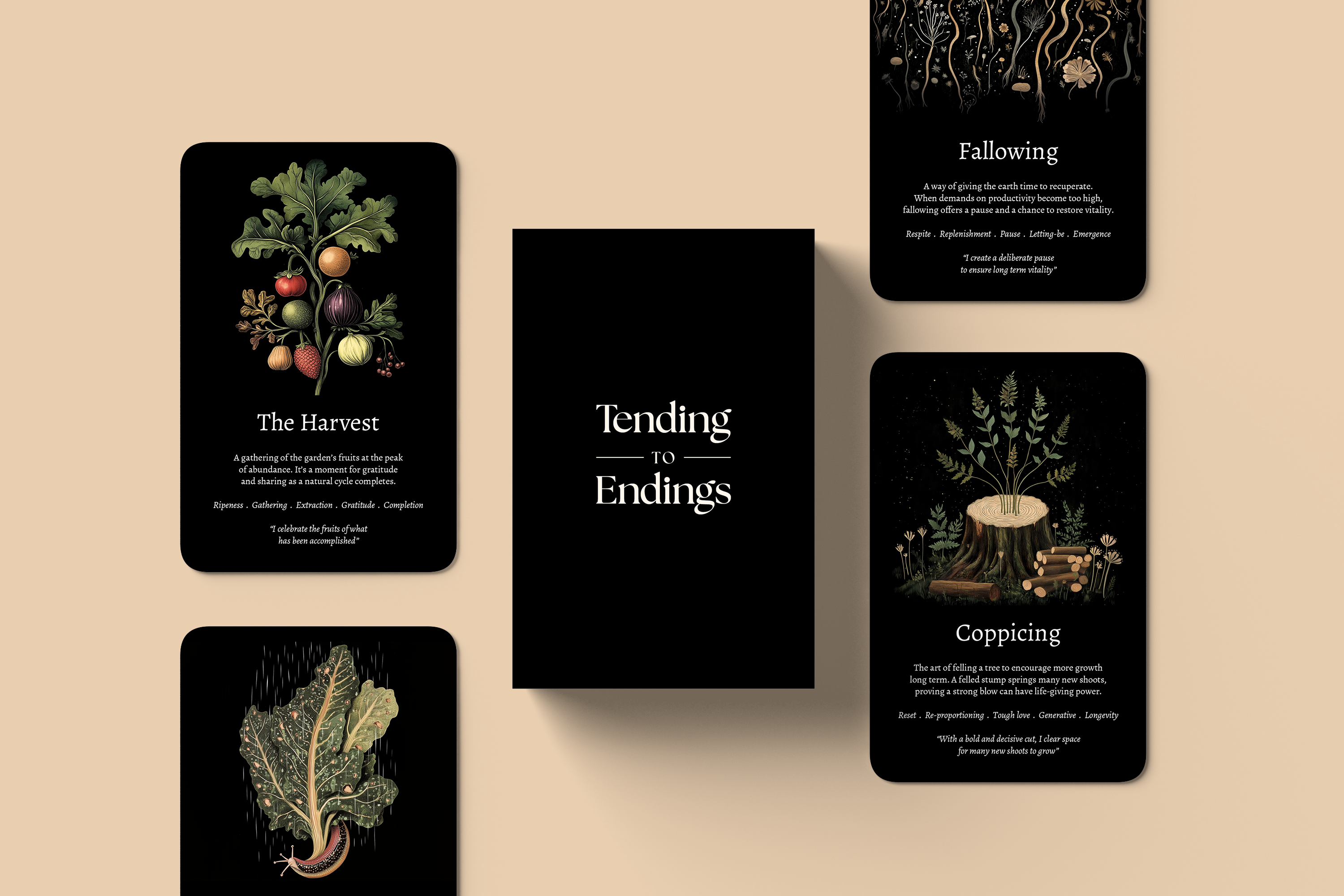
Throughout the discussions a rich quality of language grew from the ‘frame’ of gardening and from the cards.
We found natural metaphors in this way both enlightening AND reassuring – reassuring perhaps because we ARE nature – we are a human system in the same way as a garden is an ecosystem and so our responses feel aligned with those we ‘observe’ in the natural world where gardening itself is a nurturing activity.
We found that different cards worked well with different endings. The group shared professional endings they felt ambivalent about – where metaphors such as “harvesting” felt too positive – implying projects were closing at the right time and without honouring the messiness of reality. This really showed us how each card has its gifts and challenges, but often it is the less obvious metaphors that can provide richer instruction.
We noted that projects that have run out of funding (or steam) are often left hanging in strange limbos instead of being “closed well” – partly not to disappoint stakeholders, or because there’s always a hope they can be re-energised – but in staying in this state we forgo the necessary act of returning a project to ground and the positive closure, resolution or acceptance, & reset this brings.
Throughout our discussions we were led into wider reflections around change that is nurturing; cyclical; unpredictable, uncertain; involving dying back and new growth. The metaphors showed us that we are never static/always changing – that endings are often ushering in a new phase or new beginning.
Here are some quotes from participants
Sometimes it takes time to see what the new shoots are – the tree can cloud our vision
It is hard to keep the faith that new shoots will appear. It is almost like suspending judgement to observe what happens.
Changing the narrative so we don’t just talk about the end but also those things that will continue e.g. skills taken forward from a role even though a project is finishing, ideas sparked.
A sense of agency and the prompts on the cards can help you to find your own sense of closure even if the ending you’re facing doesn’t naturally provide that closure.
Compost – While it was a positive affirmation of my own feelings around and experience of a project’s ending, it made me wonder how the community group I had left might respond to the same metaphor.
Fallowing – and the session gave me confidence to advocate for it at senior level.
A project reflective journal can also be very helpful for providing that space for creativity and fallowing
Further reading shared during the session
For more about Tending to Endings – and to sign up for their newsletter and information about purchasing the card deck
https://www.tendingtoendings.com
Here is link to the Collective Imagination Practice community from which Tending to Endings emerged
https://www.linkedin.com/company/collective-imagination-practice-community
This is the Decelerator – a support service for civil society organisations offering information and tools for better endings.
https://www.linkedin.com/company/the-decelerator-uk
Michael Kearney writes about deep resilience:
https://www.michaelkearneymd.com
Read about other sessions in our Open Workshop Programme HERE.